

The 2025-11-25 MCP specification update introduces major changes to improve how AI applications and servers handle tasks, security, and integrations. Here’s what you need to know:
- Asynchronous tasks: Servers can now manage long-running operations like data analysis or complex calculations without needing constant connections or workarounds.
- Security upgrades: Better authorization controls, including OAuth support, enable more secure and efficient machine-to-machine workflows.
- Extensions and sampling improvements: Developers can add features without disrupting existing setups, while refined sampling tools simplify AI model interactions.
- Developer experience fixes: Clearer guidelines, standardized error codes, and better version negotiation make server setups and SDK development more predictable.
For end users, this means smoother functionality and better control over data. Server providers gain tools to build more secure and efficient systems. Tools like MCP Bundler simplify managing these updates, offering centralized control and easier configuration.
MCP at One Year: Major Spec Update for Production Agents
Major Changes in the 2025-11-25 Specification
The November 25, 2025 update introduces three key updates that redefine how MCP handles operations, secures data, and supports customization. These changes directly tackle challenges identified over the past year.
Asynchronous Tasks and Long-Running Operations
MCP servers previously faced difficulties managing long-running operations. The introduction of the Tasks primitive (SEP-1686) changes this by standardizing how these operations are tracked. Clients can now query progress and retrieve results over a set period, making the process more efficient and transparent.
Tasks follow a structured lifecycle with five states: working, input_required, completed, failed, and cancelled. This structure provides clear visibility into an operation’s progress. For example, a healthcare server analyzing patient data over several hours can now allow clients to check the status periodically without needing a constant connection. This is particularly helpful for scenarios like code migration, test execution platforms, or multi-agent systems requiring isolated sessions.
| Before Tasks | After Tasks |
|---|---|
| Custom timeout handling was required | Standardized polling mechanism introduced |
| No visibility into progress | Five lifecycle states ensure transparency |
| Connection had to remain open | Results retrievable within a defined time frame |
| Limited multi-step workflow support | Supports operations needing additional input |
| Workarounds for long tasks were complex | Built-in task isolation with security boundaries |
While the Tasks feature is currently marked as experimental, it’s expected to evolve based on real-world use and community input.
The next update focuses on bolstering security measures.
Security and Authorization Updates
In addition to better task management, this update enhances MCP’s security framework. It introduces OAuth client credentials support (SEP-1046), simplifying machine-to-machine authorization. Servers can now securely authenticate without requiring user interaction, streamlining processes for automated workflows.
Another major improvement is Cross App Access (SEP-990). Enterprise users can now sign in once through an MCP client and gain seamless access to all authorized servers. This eliminates the need for repeated logins across multiple servers, significantly reducing friction in environments that rely on diverse data sources and tools.
Other updates include clearer OAuth scope definitions and improved credential handling, ensuring stronger compliance and data protection.
Extensions and Advanced Sampling Features
The new extensions framework adds flexibility by allowing optional, independently versioned components. These extensions are designed to work alongside the core specification, enabling developers to test and implement new features without disrupting the protocol’s stability. This approach encourages experimentation and faster development cycles.
One standout addition is Sampling with Tools (SEP-1577). This feature allows MCP servers to define tools and specify tool selection behavior within sampling requests. Servers can now deploy internal agents under client tokens, simplifying the division of tasks between servers and clients. For example, research servers can initiate internal agents to coordinate tasks and deliver cohesive results, all while using standard MCP processes.
This update also replaces the confusing includeContext parameter with explicit capability declarations. This change gives servers greater control over how context is handled in sampling requests, resolving ambiguities and enabling precise management. Enhanced server-side agent capabilities further streamline complex reasoning processes, reducing the load on clients.
These updates, combined with earlier improvements, ensure MCP continues to offer robust functionality and security for its users.
Developer Experience and Interoperability Updates
The November 25, 2025 update brings key refinements to MCP, making it more predictable and easier to use for developers. By addressing challenges identified during its first year, these updates aim to improve the overall experience for those working with the protocol.
Specification Cleanups and Fixes
This update introduces several targeted improvements designed to smooth out the development process. Tool name standardization ensures consistent naming conventions across servers, reducing confusion and making configurations more straightforward. Streaming improvements enhance the way data flows between clients and servers, offering clearer guidelines for handling partial responses and managing connection interruptions. These changes are especially helpful for applications that process large datasets or operate in environments with unreliable connectivity.
Another major improvement is in specification version negotiation. The protocol now includes a more transparent handshake process, enabling clients and servers to identify and agree on supported features before exchanging data. When a client connects, both sides explicitly declare their capabilities, and the protocol automatically determines the best feature set they can use together.
Additionally, standardized error codes and expanded documentation make debugging faster and integration smoother. Edge cases that previously caused confusion are now clearly addressed with recommended solutions.
Benefits for SDK Authors and Server Providers
These updates offer practical benefits for both SDK developers and server providers. For SDK authors, the clearer specifications mean less time spent handling edge cases and more predictable behavior across different server implementations. This reduces the maintenance burden when building libraries that wrap MCP functionality.
Server providers also gain from these refinements. The streamlined version negotiation process allows servers to support multiple specification versions at once without relying on complex branching logic. The protocol now automatically detects features and manages fallback behavior, making upgrades simpler and more stable. This benefits end users by ensuring consistent application performance while reducing maintenance headaches for providers.
For teams managing multiple MCP servers, operations become more efficient. Standardized reporting formats improve the accuracy of health monitoring, and predictable tool names simplify configuration management.
These enhancements make MCP a more robust protocol capable of handling real-world complexities. Developers can now focus on building features that matter to end users instead of navigating unclear specifications. Tools like MCP Bundler also benefit from these refinements, enabling more efficient centralized server management and further streamlining the development process.
sbb-itb-5209627
Using the New Specification with MCP Bundler
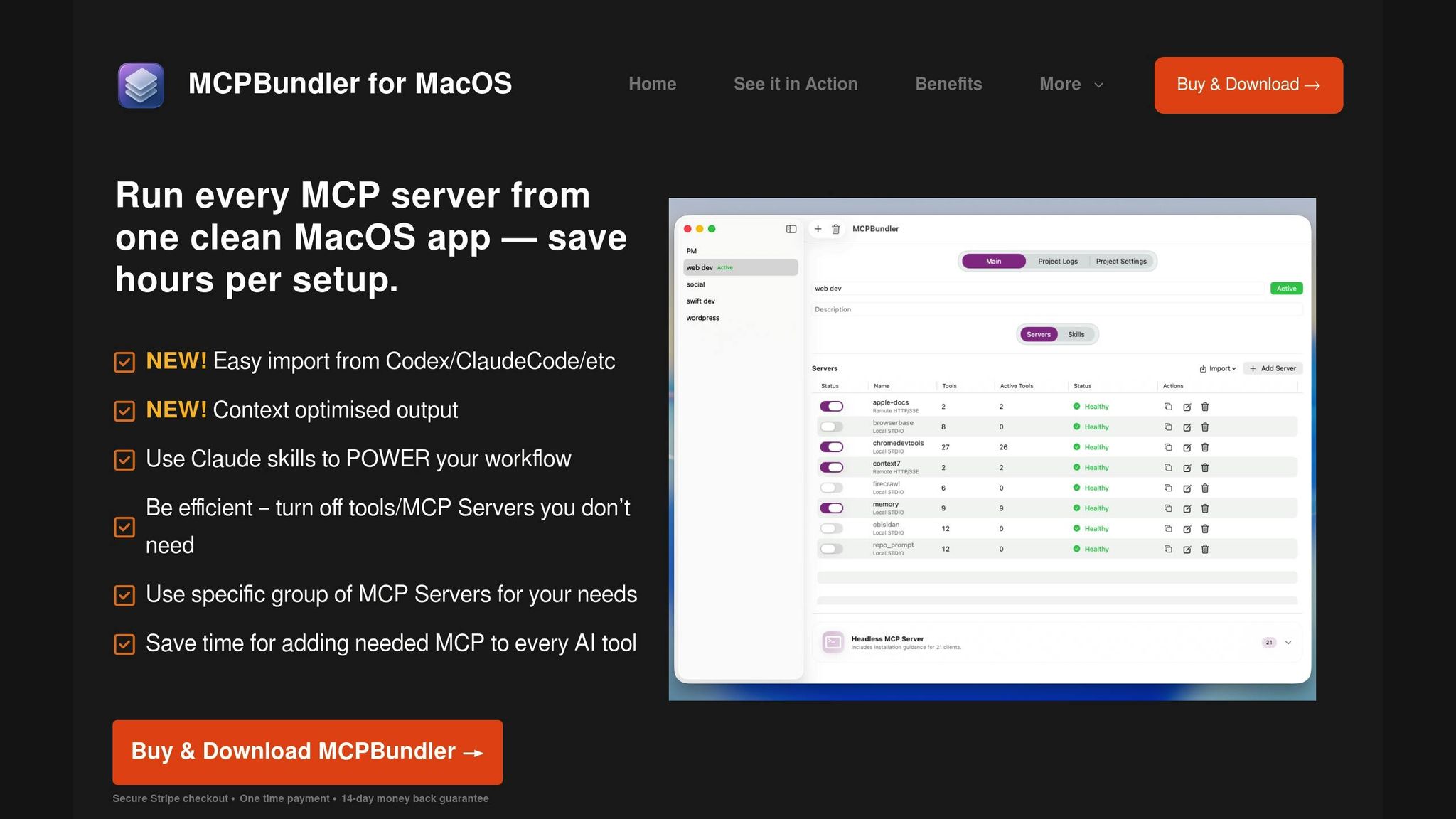
The November 25, 2025, MCP specification brings a host of advanced features that, while powerful, can make managing servers more challenging. That’s where MCP Bundler steps in – it simplifies server management by offering a centralized platform to handle MCP servers running the latest specification.
Centralized Server Management
MCP Bundler provides a unified control panel that brings all your MCP servers together in one place. Instead of wrestling with manual configurations, you can oversee everything from a single interface. With one-click controls, enabling or disabling servers to align with your workflow becomes quick and easy.
Real-time health monitoring gives you a clear picture of server activity, whether they’re processing tasks, active, or facing issues. Detailed logs help you troubleshoot effectively, ensuring you stay on top of performance. Plus, granular control allows you to activate only the tools you need, keeping your workspace clean and efficient.
Simplifying Operations
Beyond feature management, MCP Bundler streamlines daily operations. Auto-archiving prevents errors by managing large responses, while easy import tools let you migrate existing server configurations with minimal effort.
For teams juggling multiple servers across various projects, this efficiency reduces operational headaches, allowing you to focus on creating AI-driven features for your users.
Best of all, MCP Bundler operates on a one-time payment model – just $15 for lifetime access. This includes all future updates and comes without telemetry, offering a budget-friendly and privacy-conscious solution for server management.
Conclusion
The November 25, 2025, MCP specification introduces a range of updates designed to elevate functionality for both end users and server providers. Here’s a quick overview of the most impactful changes.
Key Updates in This Release
The latest specification brings four major advancements:
- Asynchronous task handling: Long-running operations no longer result in frustrating timeouts, enabling servers to handle complex workflows without disrupting other processes.
- Enhanced security and authorization: Granular access controls now allow for precise management of sensitive operations, boosting overall security.
- Extensions and advanced sampling: These features let developers customize AI behavior and add specialized capabilities beyond the core offerings.
- Improved developer experience: Resolved inconsistencies make it easier for SDK authors to create dependable implementations, cutting down debugging time for server providers.
With these updates, transitioning to the new specification can be seamless if approached strategically.
Steps to Transition
For end users, it’s important to ensure your MCP servers support the new features. Tools like MCP Bundler can simplify this process by offering centralized monitoring and configuration management, so you don’t have to manually check each server.
For server providers, the focus should be on implementing asynchronous task support and updating security protocols. Carefully review the specification for deprecated patterns and begin integrating new features incrementally. Testing these changes with real-world scenarios will ensure a smoother transition.
If you’re managing multiple servers, centralized tools like MCP Bundler are invaluable for handling the growing complexity of features, making it easier to align with the new specification.
The November 2025 updates mark a significant step forward for the MCP ecosystem, allowing for more secure, flexible, and reliable AI applications.
FAQs
How do the new asynchronous task features in the November 25, 2025 MCP specification enhance server performance and user experience?
The November 25, 2025 MCP specification brings a game-changer with its asynchronous task features, aimed at boosting server efficiency and improving user interactions. By introducing durable requests, along with polling and deferred result retrieval, servers can now manage tasks more effectively. This reduces server load and helps keep latency to a minimum.
On the user side, these updates translate to smoother, non-blocking experiences. Background task processing ensures workflows aren’t interrupted, while real-time updates and progress tracking give users more control. Even during complex operations, the result is a more responsive and seamless experience.
What new security features does the latest MCP specification include, and how do they help server providers?
The latest MCP specification brings forward some key updates aimed at boosting security and efficiency for server providers. Among these updates are enhanced authorization server discovery through support for OpenID Connect Discovery 1.0, improvements in authorization flows using incremental scope consent via the WWW-Authenticate header, and the introduction of OAuth Client ID Metadata Documents as a recommended method for client registration.
These additions not only tighten security measures but also make client registration simpler and authorization processes smoother. For server providers, this means a more dependable and efficient system to manage access and protect sensitive data.
How does the new extensions framework in the 2025-11-25 MCP specification speed up AI development and allow for better customization?
The 2025-11-25 MCP specification brings a fresh extensions framework aimed at simplifying AI application development while allowing for greater customization. This framework equips developers with tools to seamlessly add features, adjust workflows, and create solutions tailored to specific requirements.
With its modular design and straightforward implementation process, the framework helps cut down on development time while providing the flexibility needed for specialized use cases. This approach empowers both end users and server providers to innovate and expand AI applications with ease and efficiency.